Anchor text percentages: what the numbers actually mean
Every guide hands you a table: 40% branded, 20% naked, under 10% exact match. None of them tell you where those numbers came from. Here's the honest version.
Published July 29, 2026
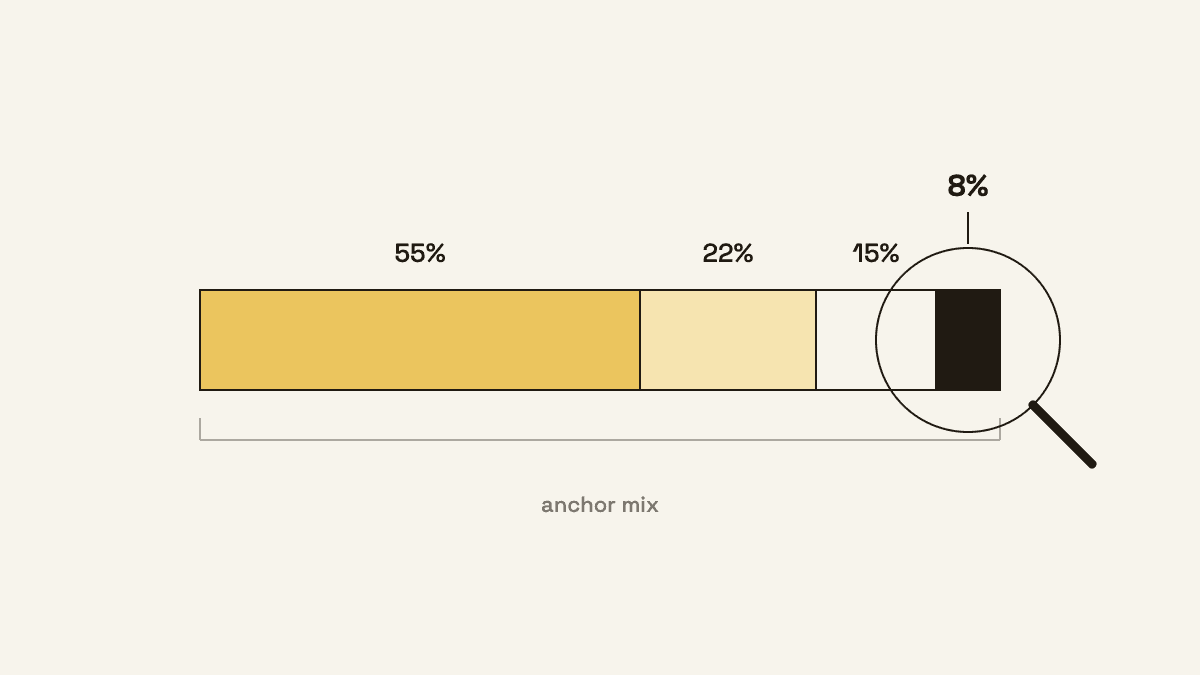
Anchor text is the clickable words in a link. Google uses it to work out what the destination page is about, which is why an anchor stuffed with your target keyword is a ranking signal — and why a profile full of them is a spam signal.
That much is uncontroversial. Everything after it is inference, and the inference is usually presented as fact.
Where the percentages come from
Google has never published a safe anchor text distribution. Not in the Search Essentials, not in a Search Central video, not in the leaked documentation. The Penguin update in 2012 made over-optimised anchors expensive, and the industry responded by reverse-engineering a target from the profiles of sites that survived.
That reverse-engineering was real work and the conclusions are broadly sensible. But it produced a distribution that describes what natural link profiles look like, and then everyone started treating it as a threshold you must not cross. Those are different claims. The first is an observation; the second is a rule nobody has ever confirmed exists.
The distribution worth aiming at
With that caveat established, here is the split most experienced link auditors work to. Treat it as a description of a healthy profile, not a compliance target:
| Anchor type | Share | Example |
|---|---|---|
| Branded | 30–60% | Acme, Acme Inc |
| Partial match | 10–30% | Acme's returns software |
| Naked URL | 10–25% | acme.com |
| Generic | 5–20% | click here, read more |
| Exact match | 0–10% | returns software |
The single most important row is the first one. Branded anchors should dominate, because that's what happens when real editors link to you — they use your name. A profile with almost no branded anchors reads as bought regardless of how clean the individual links look, and no amount of tuning the other rows fixes it.
The footprint nobody checks for
Percentages by type are the standard audit. There's a second pattern that matters more and gets checked less: how much of your profile sits on one exact string.
A profile can be 8% exact match — comfortably inside every recommended band — and still have every one of those links using the identical phrase, placed within the same three months. Natural linking doesn't produce that. Even a perfectly safe-looking distribution becomes a footprint when a single anchor is repeated at scale.
Vary the phrasing. Two links reading "returns software for ecommerce" and "software for handling ecommerce returns" carry nearly the same relevance signal and don't look coordinated.
Check your own distribution
Paste your anchor list and see the split, plus whether a single anchor is holding too much of it. Runs in your browser — nothing is uploaded.
What to do if exact match is too high
The instinct is to remove links. Usually wrong — you paid for them, and removal loses the relevance along with the risk. In order of what actually helps:
- Dilute. Build branded and partial-match links until the ratio moves. This is slower than pruning and it's the option that doesn't cost you signal.
- Fix what you control. Internal links and your own profiles are yours to edit — start there, they're free.
- Request changes on the worst offenders. Publishers will often adjust an anchor on request; it costs them nothing.
- Disavow only for links you'd be embarrassed by on their own merits. A disavow file is not an anchor-ratio tool, and Google largely ignores it now.
The part that matters more than any of this
Anchor text is a tuning parameter on a signal that's already either strong or weak. A well-distributed profile of links from irrelevant, traffic-free sites does nothing. A slightly over-optimised profile of links from sites your audience actually reads works anyway.
If you're spending real time on anchor ratios and no time on whether the publishers are topically relevant, you're optimising the wrong variable. Get the sites right first. The anchors are the easy part.
See which sites are actually relevant
LinkRadar scores publishers by backlink intersection with your competitors and semantic fit with your niche — then shows which ones you can buy.