llms.txt: what it is, and whether it's worth your time
It's a markdown file at your site root that lists the pages you'd like an AI assistant to read. That's the whole idea. The interesting question is whether anything reads it.
Published July 29, 2026
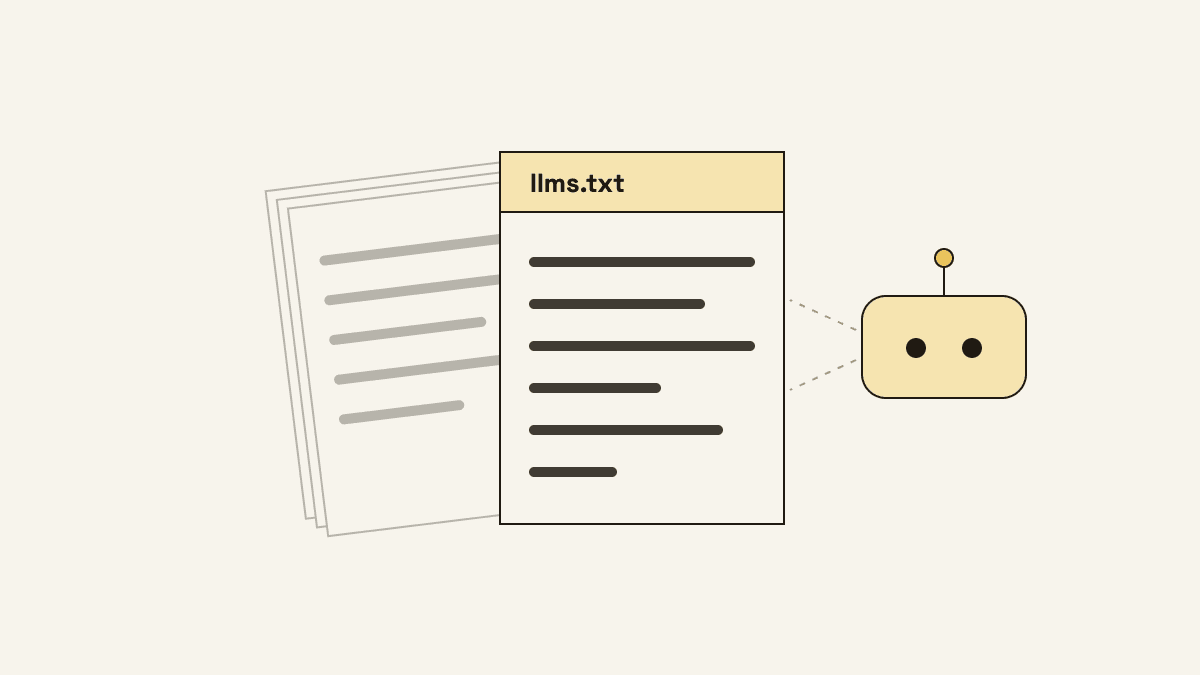
Proposed by Jeremy Howard in 2024, llms.txt borrows its shape from robots.txt and sitemap.xml: a single well-known file that tells automated readers something useful about your site. Where robots.txt says what not to crawl, llms.txt says what's worth reading — and, crucially, points at clean documentation rather than pages wrapped in navigation and cookie banners.
What's actually in the file
Plain markdown, in a defined order. An H1 with your site name, an optional blockquote summary, optional prose, then H2 sections containing lists of markdown links with optional descriptions:
# Acme

> Returns software for ecommerce teams shipping 1,000+ orders a month.

Acme handles returns end to end: labels, tracking, restocking and refunds.

## Docs

- [Getting started](https://acme.com/docs/start): install, configure, first sync
- [API reference](https://acme.com/api): endpoints, auth, rate limits

## Optional

- [Changelog](https://acme.com/changelog): release history
The one piece of the convention people miss: a section literally named "Optional" signals that a reader on a tight context budget can skip it. That's the only priority mechanism in the format, and almost nobody uses it.
Generate one now
Fill in a form, get a valid file, download it. Validates as you type and runs entirely in your browser.
Who reads it
This is where honesty is required. As of mid-2026, no major AI company has publicly committed to reading llms.txt as part of retrieval or training. Not OpenAI, not Anthropic, not Google, not Perplexity.
Some developer-tool ecosystems do consume it, and a number of documentation platforms now generate one automatically. But if you publish llms.txt expecting ChatGPT to start citing you, that expectation isn't supported by anything anyone has announced.
What llms.txt is not
- Not a ranking factor. It has no relationship to Google Search.
- Not a way to get cited. Answer engines cite sources they already trust; a file at your root doesn't create trust.
- Not a robots.txt replacement. It grants nothing and blocks nothing — it has no access-control semantics at all.
- Not a standard. It's a proposal. Nobody is obliged to honour it and the format may change.
What actually gets you cited
Answer engines assemble responses from sources they already weight highly — established publications, documentation they've seen referenced repeatedly, pages with clear structure on domains with a history. Getting into that set is the same problem as getting into search results, approached from a slightly different angle.
Which means the boring work still dominates: be written about on sites those models already read, keep your own pages parseable, and answer questions directly enough to be quotable. A model reaches for a sentence it can lift whole — bury the answer in three paragraphs of preamble and it takes someone else's.
We wrote a longer piece on the limits of what anyone can promise here, including why guaranteed AI citations aren't a thing:
How citations actually relate to placements
The honest version, including what we can't promise and why.