Someone quoted you a price. Five checks before you pay it
A quote arrives: $600, one dofollow link, article included. There is no explanation attached, because there almost never is. Here are five checks that tell you what you are actually looking at.
Published August 16, 2026
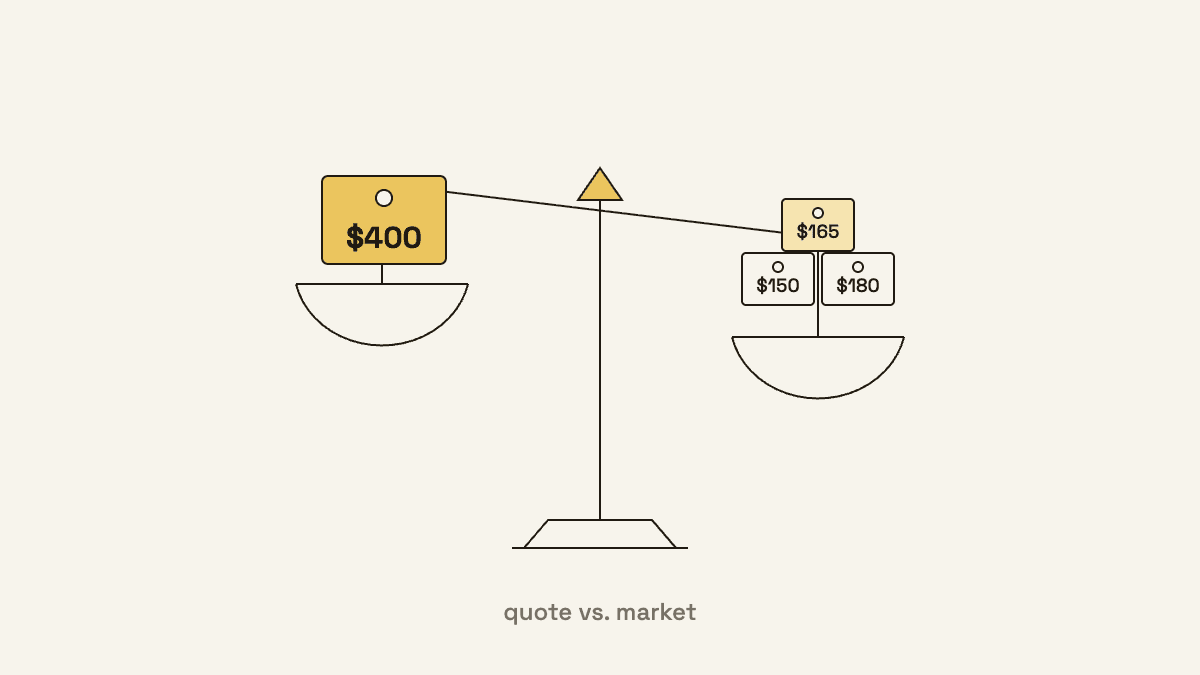
Backlink pricing is opaque by design. The seller knows what the publisher charges and what they added; you know only the final number. That asymmetry is the entire business model of a link reseller, and it is why the same domain can be quoted at $200 and $900 in the same week.
You cannot close that gap completely. You can narrow it enough that a bad deal becomes obvious.
Check 1: does the traffic justify the authority?
Domain Rating is the number everyone quotes and the easiest to inflate. A DR 70 site with 400 monthly visits has been built to sell links, not to have readers. A DR 45 site with 60,000 visits is a real publication that happens to score modestly.
The rough sanity check: if organic traffic in thousands is smaller than the domain rating, ask why. There are legitimate answers — a young site, a niche in a small market, a brand that ranks for few keywords but gets direct traffic — and there is one illegitimate one, which is that the authority was manufactured.
Check 2: what does the rest of the market charge for this domain?
This is the check that most buyers skip because it looks impossible, and it is the one that saves the most money. The same publisher usually appears on several marketplaces at several prices. The spread between them is the reseller's margin, made visible.
Check a domain's price
Median, average and highest market listing for any publisher in the catalogue.
Check 3: is the price attached to the page or the domain?
A link in a new article on a buried URL is worth less than a link added to a page that already ranks and already has links pointing at it. Many quotes do not distinguish. Ask which one you are buying, and what the URL will be.
If the seller cannot tell you the destination URL before you pay, you are buying a lottery ticket at a fixed price.
Check 4: what happens if it disappears?
Links come down. Editors rewrite posts, sites migrate, pages 404. The question is not whether it will happen but what the arrangement says when it does.
- Is there a stated minimum period the link stays live?
- Who checks that it is still there — you, or them?
- What is the remedy: replacement, refund, or nothing?
Most quotes are silent on all three. Silence means the answer is 'nothing', and you should price that into what you are willing to pay.
Check 5: does the price move when you ask a second time?
A price built from a real cost — what the publisher charges, plus a stated margin — is stable. A price built from what the seller thinks you will pay moves when you push back. That is diagnostic, and it is free to test.
What a fair price actually looks like
Across our own catalogue of 225,000+ publishers, the median listing price is $140 and 66% of listings sit under the market median we can observe elsewhere. That is not a universal law — it reflects buying direct rather than through a chain — but it gives you an anchor.
| Signal | Fair | Worth questioning |
|---|---|---|
| Traffic vs authority | Traffic in thousands ≥ DR | DR far ahead of traffic |
| Vs market median | At or under | 2× or more above |
| Destination URL | Known before payment | Assigned after |
| Link lifetime | Stated period | Unspecified |
| Price stability | Unchanged on a second ask | Drops when pushed |
None of these require a subscription. Four of them require ten minutes. The fifth requires the willingness to ask a question you might not like the answer to, which is usually the one that pays for itself.