Where an agency's link-building margin actually goes
A £2,000 monthly link retainer looks like a good line of business until you count the hours behind it. Here is where the margin actually goes, in the order it usually leaks.
Published August 16, 2026
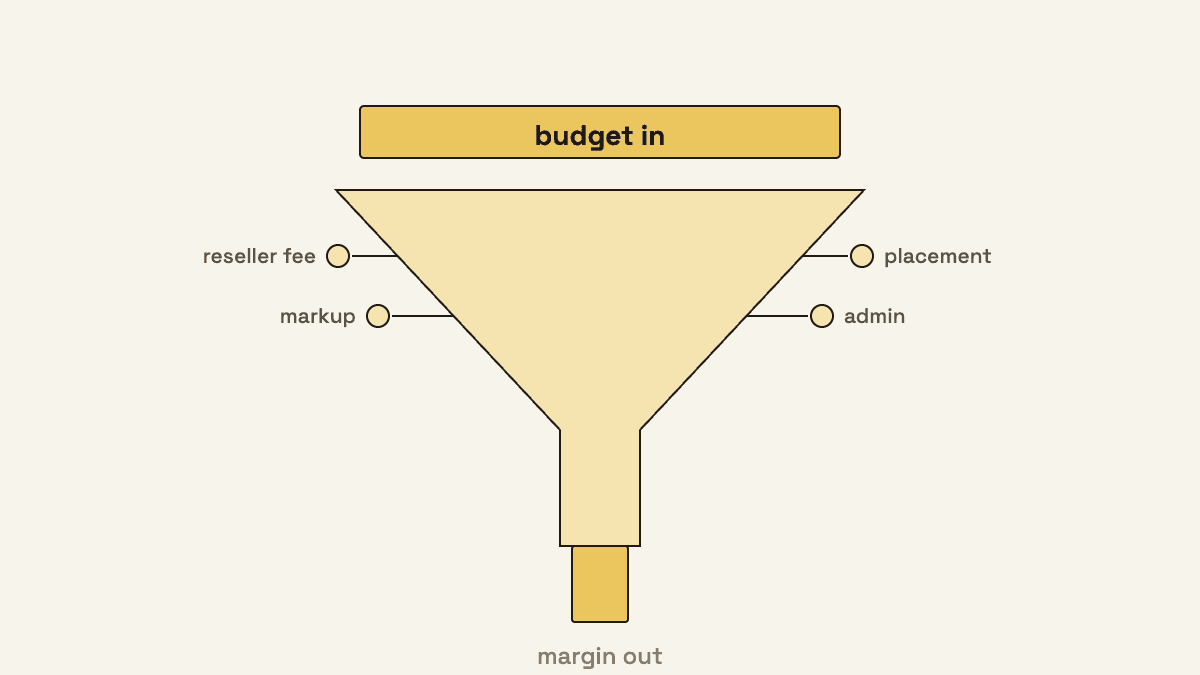
Most agencies price link building on the placement: a client pays for six links a month, the agency buys six links, and the difference is the margin. On paper it is a clean resale business. In practice the paper leaves out four costs, and together they are usually larger than the markup.
Leak 1: sourcing time nobody bills
Finding a placement is not one action. It is building a prospect list, filtering it for quality, checking each candidate against what the client already has, requesting prices, waiting, and rejecting most of what comes back.
Two to four hours per client per month is typical, and almost nobody bills it as a line. At a £75 blended rate that is £150–£300 gone before a single placement is bought — on a retainer that might only carry £600 of gross margin.
Leak 2: paying the reseller spread without seeing it
When the same publisher is quoted at wildly different prices by different sellers, the spread is somebody's margin. If you are buying through a chain, it is not yours.
This is the leak that scales the worst: it is invisible per-placement and enormous per-year. Six placements a month across eight clients is 576 placements a year. An average £70 of hidden spread on each is over £40,000 that left the business without ever appearing as a cost line.
Check what a domain costs
Median, average and highest market listing — so a quote becomes a position in a range.
Leak 3: rework caused by missing context
Two failures repeat across agencies. The first is buying a domain the client already has a link from, which is pure loss. The second is content that comes back off-brief because whoever wrote it did not have the client's positioning, and now someone senior is rewriting it.
Both are context problems rather than effort problems. Both are solved by holding the client's link profile and brief somewhere the work can see them, rather than in an inbox.
How Linkprofile prevents this
Import each client's existing links once — duplicates stop being recommended, and every link is re-checked weekly.
Leak 4: reporting and admin at month end
Collecting live URLs, checking they are still live, assembling a spend summary, and writing the update. Two hours per client per month is normal; on eight clients that is a working day, monthly, that no one invoices.
What the maths actually looks like
| Line | Per client / month | Notes |
|---|---|---|
| Client pays | £2,000 | Six placements, retainer |
| Placement cost | £900 | Six at £150 average |
| Hidden reseller spread | £240 | If bought through a chain |
| Sourcing time | £225 | 3h at £75 |
| Reporting and admin | £150 | 2h at £75 |
| Rework | £120 | One rewritten article, amortised |
| Actual margin | £365 | 18% — not the 55% on the proposal |
The proposal said 55%. The business is running at 18%, and the difference is entirely in costs nobody wrote down.
The three fixes, in order of payoff
- Buy where the price is visible. Removing the hidden spread is the single largest recovery and it costs no extra hours.
- Hold each client's link profile in one place. It kills duplicate purchases and shortens every sourcing pass.
- Bill the admin, or automate it. Reporting that assembles itself from order records is the difference between a working day and a coffee.
None of this changes what you charge the client. It changes how much of it you keep — which is the only number the agency actually lives on.
See the agency setup
A project per client, listing prices you can see, and reporting that assembles itself.